 English
 Español
Just write us your request & we will take care of the rest.
What Materials Are Commonly Used for Hexagon Bolts?
A finished machine may contain hundreds of individual fasteners, but few receive as much everyday attention as hexagon bolts. Their familiar six-sided heads appear in construction equipment, industrial machinery, transportation systems, agricultural equipment, and factory installations. Behind this common component is a manufacturing process that emphasizes dimensional consistency, material selection, and precision forming.
Material Choices Depend on Application Requirements
The performance of hexagon bolts begins with raw material selection. Carbon steel remains a widely used option for many industrial assemblies because it offers dependable mechanical properties and can be processed efficiently during large-scale production.
Alloy steel is often selected when assemblies require greater structural strength or resistance to repeated loading. Stainless steel is another common material, particularly for equipment installed in humid locations or food processing environments where surface appearance and corrosion resistance are important considerations.
Manufacturers carefully inspect incoming wire rods or steel bars before production begins, helping ensure that every batch meets dimensional and material specifications required for downstream processing.
Cold Heading Creates the Basic Bolt Shape
The manufacturing journey of a hexagon bolt starts with wire preparation. Steel wire is straightened, cut into measured lengths, and transferred into cold heading machines.
Cold heading uses specially designed dies to form the bolt head without removing material. This production method creates the familiar hexagonal shape while maintaining efficient material utilization. After the head is formed, the bolt blank moves to thread rolling equipment.
Instead of cutting threads, many manufacturers use thread rolling technology. Hardened dies press thread patterns into the bolt surface, creating smooth and accurate threads with consistent dimensions. This process also supports high production efficiency for large manufacturing volumes.
Precision Inspection Throughout Production
Maintaining dimensional accuracy is essential because hexagon bolts are expected to fit standard nuts and threaded holes across different industries.
Manufacturers perform inspections at multiple stages of production. Automated measuring systems verify head dimensions, shank diameter, thread pitch, and overall bolt length. Thread gauges confirm compatibility with standard fastening systems, while visual inspections identify surface irregularities before packaging.
Sampling procedures are commonly integrated into production lines, allowing operators to detect small variations early and make timely equipment adjustments.
Custom Production Supports Diverse Industries
Although standardized sizes remain widely used, many industrial customers request customized hexagon bolts designed for specialized equipment.
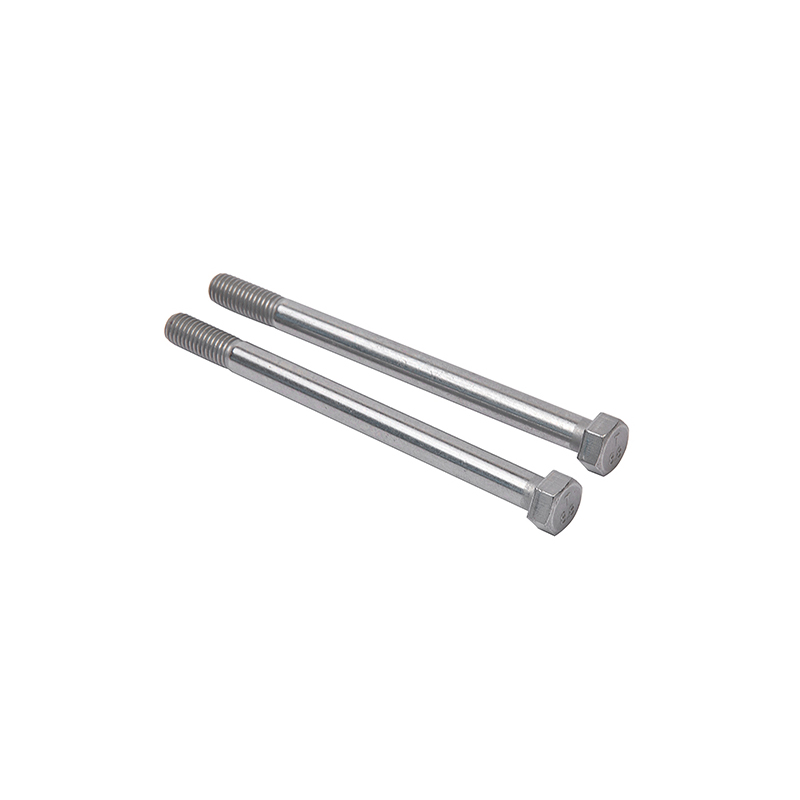
Manufacturers can adjust thread length, head dimensions, shank configuration, overall length, and surface finish according to engineering drawings. Some projects require partially threaded bolts, while others specify fully threaded designs or unique dimensional tolerances.
Customized packaging also supports industrial supply chains. Hexagon bolts may be organized by size, project number, or assembly sequence, making inventory management and production planning more efficient for customers.
Automation Improves Manufacturing Efficiency
Modern fastener factories increasingly integrate automation into hexagon bolt production. Robotic handling systems transport materials between manufacturing stations, reducing manual operations and supporting stable production flow.
Digital monitoring systems continuously record machine performance, forming pressure, thread rolling conditions, and production speed. Operators use this information to maintain process consistency across extended production runs.
Advanced tooling design also allows manufacturers to switch between different bolt sizes more efficiently, helping factories respond quickly to changing order requirements while maintaining reliable dimensional consistency.
Related Products

Copyright 2024 Zhejiang Wanyu Automotive Parts Co., Ltd. All Rights Reserved
Auto Fasteners Parts Factory

Contact Us